


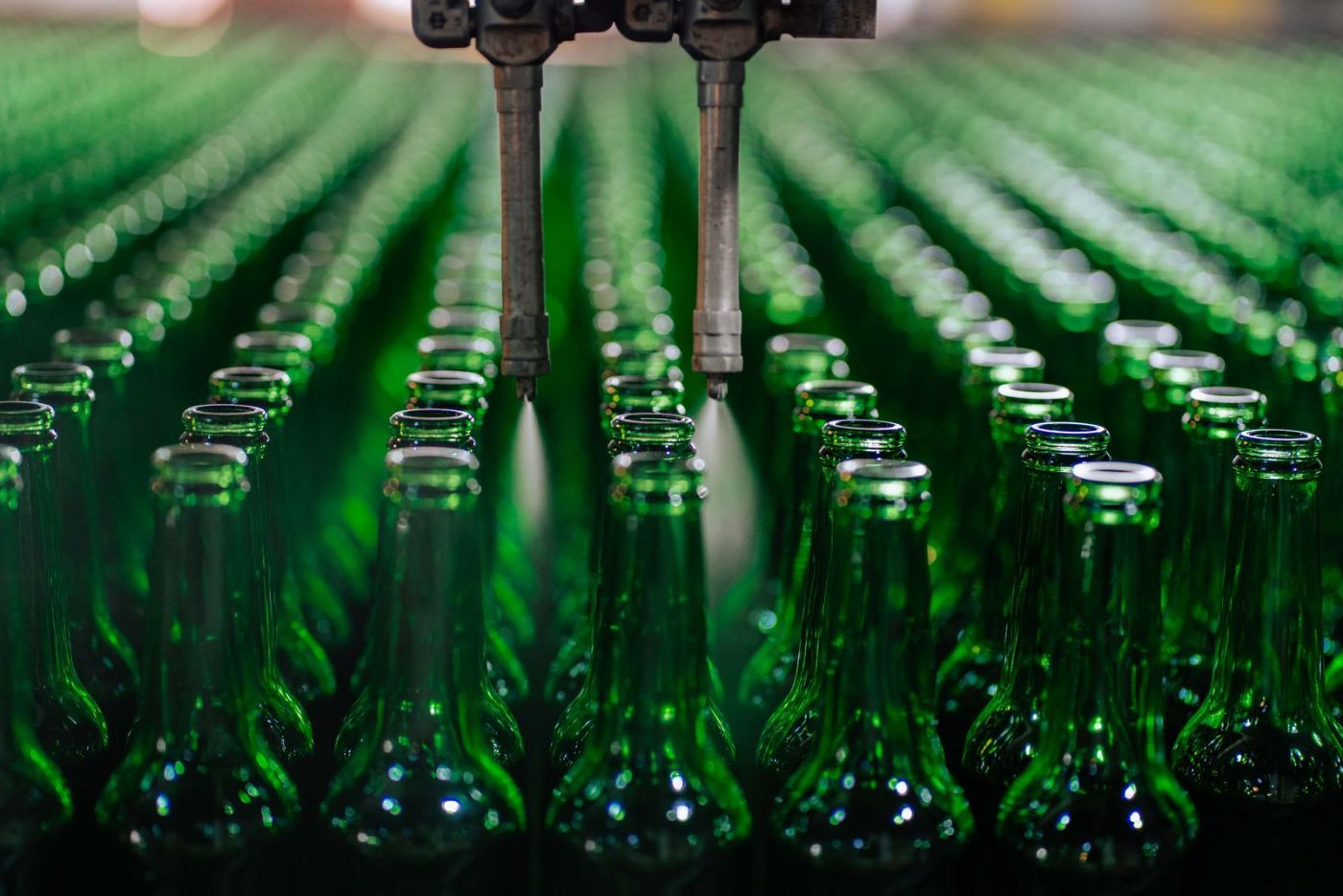
A filler running 12,000 bottles an hour, one shift a day, 250 days a year, gives away roughly 180,000 litres of product annually if it runs 1.5% heavy. Nobody signs off on that number. It arrives in increments — a nozzle that drips, a tank that foams, a product that thickens after lunch — and by the time anyone weighs a bottle, the loss has been normal for two years.
Filling accuracy is usually treated as a machine specification. In practice it is a property of the whole line, and most of what moves the number sits outside the dosing pump.
Foam is a measuring error, not a cosmetic one
Thin liquids — water, clear juice, ready-to-drink tea, low-viscosity syrup — foam when they fall into a container. A volumetric filler does not notice: it pushes 500 ml and moves on. The bottle now holds 500 ml of liquid plus 30 ml of foam, and the level sensor reads high. Operators respond the only way the machine lets them, by turning the volume down. What leaves the plant is a bottle that looked right on the line and is short on the shelf once the foam collapses.
Two fixes work, and they solve different halves of the problem:
- Dive nozzles. The nozzle travels to the bottom of the container and retracts as it fills, so liquid enters below the surface and never has a free fall to aerate. Cheapest effective change, and it belongs on any line above 6,000 bottles an hour.
- Deaeration and steady head pressure. A deaerator removes air the product is already carrying; a stable pressure at the filler bowl stops new air being pulled in at the valve. Carbonated and hot-fill products need both. Still water usually does not.
Check which method you actually bought. Lines that fill by level rather than by volume — common for clear liquids in transparent bottles — fail in the opposite direction: correct by weight, short by appearance. The correction for a level filler is not the correction for a volumetric one.
The product changes between the morning and the afternoon batch
Viscosity is not a fixed value on a spec sheet; it is a function of temperature and shear. A sauce that pumps easily at 65 °C becomes unpumpable at 40 °C. A cream that fills cleanly at the start of the shift starts stringing once the hopper cools and the pigment settles.
The symptom is easy to misread. Morning batches weigh correctly, afternoon batches drift, and the first instinct is to blame the pump seals or the load cell. What is actually happening is that the dosing chamber now takes longer to fill, so a time-based valve closes early.
What fixes it is thermal, not electronic:
- A jacketed hopper with water circulation holding product within a few degrees of the filling temperature.
- A slow agitator to keep solids and pigments in suspension — slow, because fast agitation whips in air, which is the next problem.
- Recipe parameters stored per product, so the line is not re-tuned from scratch every time the schedule changes.
Drip and stringing get blamed on the seal
Viscous product forms a thread between the nozzle and the container at the end of every stroke. That thread lands on the sealing area. The capping or sealing station then gets a complaint about leaks, and the root cause sits two stations upstream.
Slowing the machine does not fix it; it lowers output and the thread still forms. What works is a mechanical cut at the end of the stroke — a tail-cut nozzle that physically severs the product column — combined with a short suck-back that pulls the last few millimetres back into the nozzle. On thin products, suck-back alone is usually enough. On pastes, you need both, and the timing between them matters more than either setting on its own.
Changeover is where the real money hides
A line that takes two hours to change format is not a flexible line, whatever the brochure says. Run six changeovers a week and you have lost a full shift; run them daily across three SKUs and the capacity you bought never existed.
The practical target for a beverage line is 15–30 minutes, tool-free, with parameters recalled from a recipe rather than dialled in by hand. Three things have to be true for that to be realistic:
- Format parts are interchangeable by hand, without spanners, and are stored on the machine rather than in a store room.
- The recipe stores fill volume, nozzle timing, conveyor pitch and capper torque together — not volume alone.
- Guides and change parts are keyed so they can only go in one way. Most changeover time is spent correcting a part that went in backwards.
Hygiene you can actually inspect
Food-safety audits do not ask whether the machine is "hygienic". They ask for a surface finish, a drain path and a cleaning record. Design decisions decide how easy those answers are:
- Product contact surfaces at Ra ≤ 0.8 µm, 304 or 316L depending on the product's chloride load. Acidic juices and salty sauces are the ones that expose a 304 spec.
- No dead legs. Every pipe run either drains or is swept by CIP flow. A horizontal run with a closed valve at the end is a bacteria reservoir with a drain plug.
- CIP coverage you can verify. Flow, temperature, concentration and time recorded per cycle — and a spray ball pattern that reaches the top of the tank, not just the sides.
- Food-grade lubricant on chains and guides above the open-container zone, with a documented schedule.
What to specify before you sign
Most of the cost of a bad filling decision shows up after installation. These are the points worth pinning down in writing:
| Item | Ask for | Why it matters |
|---|---|---|
| Accuracy basis | ±% of set volume or ±g, stated per product viscosity, measured on your product | Nameplate accuracy is measured on water |
| Test protocol | 30-minute run on your product, 30 consecutive containers weighed, results handed over | Shows drift, not just a spot check |
| Fill method | Volumetric, level, or mass flow — named explicitly | Determines how foam and viscosity affect you |
| Changeover | Measured time for your two most common formats, with the operator who will run it | Vendor timing is done by a technician |
| Nozzle type | Tail cut, suck-back, dive stroke — with timing diagram | This is where drip and foam are decided |
| Surface finish | Ra value for product contact parts, material grade per product | Audit evidence, and chloride resistance |
| Utilities | Air consumption at working pressure, water for CIP, power per station | Retrofits get expensive when this is discovered late |
The judgment worth carrying into the purchase: buy the fill method that matches your thinnest and your thickest product, not the one that matches your bestseller. The bestseller is the product you already know how to run. The one that stops the line at 2 a.m. is the other one.
RonXin supplies filling machines and complete beverage packaging lines, and will run your product on a test machine before a line is specified — samples and target output are enough to start.